
Why Ship Owners Struggle to Get Spare Parts on Time — And What Actually Works
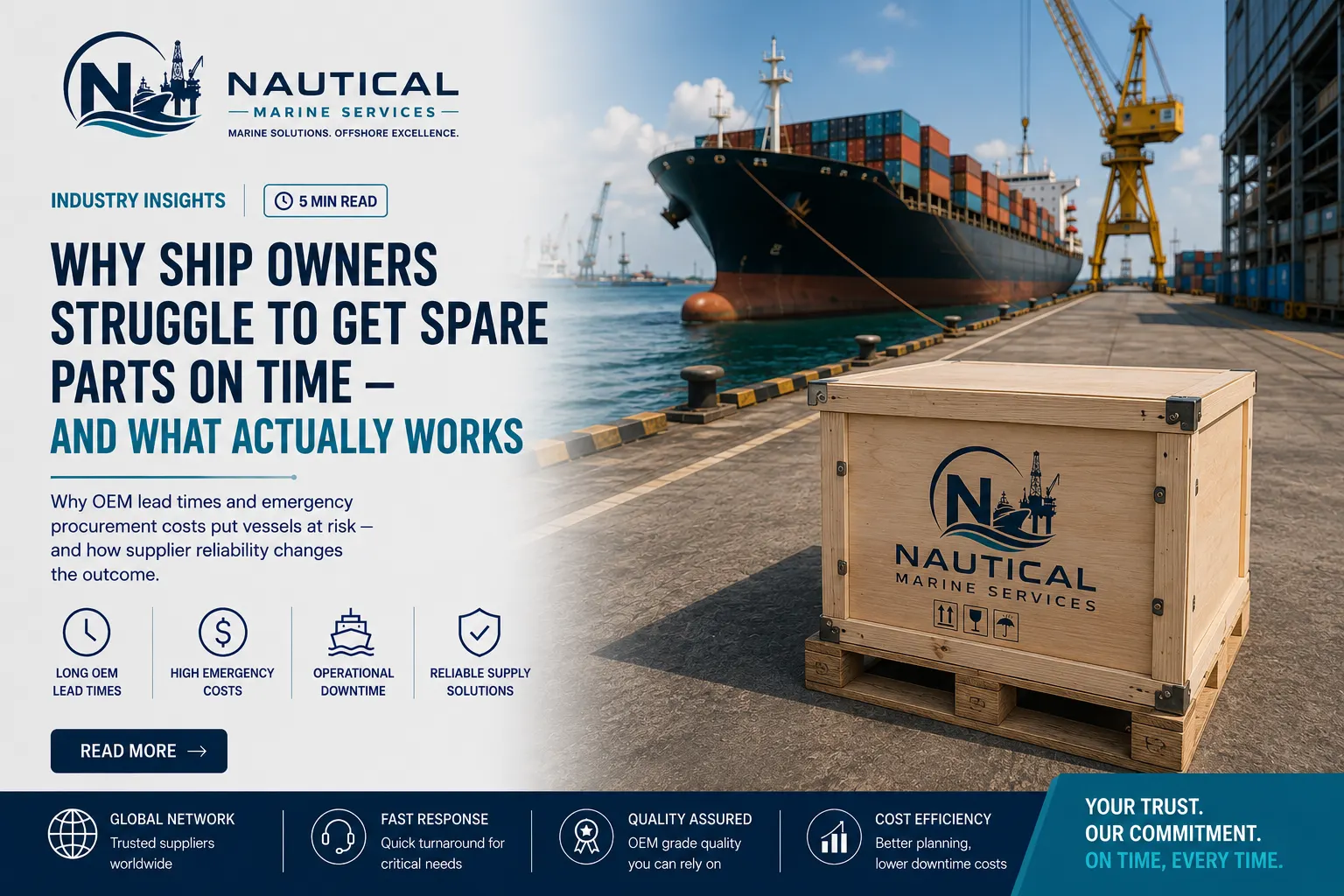
A vessel doesn't stay idle because a part is unavailable in the world. It stays idle because the part isn't available fast enough, from a supplier the operator can actually rely on.
For ship owners and operators, spare parts availability is rarely about whether a component exists somewhere — it almost always exists. The real problem is the gap between "the part exists" and "the part is on the vessel, working, before the next sailing." That gap is where downtime, missed schedules and unplanned costs come from.
Where the Delay Actually Starts
OEM lead times aren't built for vessel timelines
Original equipment manufacturers often run standard production and dispatch cycles measured in weeks. That works fine for planned maintenance. It doesn't work when a component fails mid-voyage and the vessel needs a replacement before its next port call.
Emergency procurement gets expensive fast
When a part is needed urgently, operators are often forced into rush orders, air freight and premium handling charges just to close the gap in time. What should have been a routine purchase turns into a significantly more expensive one — and the cost isn't always in the part itself, it's in everything around getting it there in time.
Supplier reliability is inconsistent
Not every supplier can respond the same way at 2 AM local time, or coordinate delivery to a vessel that's about to shift berths. Operators who depend on a single vendor often discover the gap in reliability only when they need speed the most.
Downtime costs compound quickly
A vessel held at berth isn't just losing time. It's absorbing port charges, missing charter windows, and creating knock-on delays for whatever cargo or schedule was planned around that sailing date.
The real cost of a spare parts delay is rarely the part itself — it's the downtime, the rush freight, and the schedule that has to be rebuilt around it.
Planned vs. Emergency Procurement
| Factor | Planned Procurement | Emergency Procurement |
|---|---|---|
| Typical lead time | Days to a few weeks | Hours to 1-2 days |
| Cost impact | Standard pricing | Rush freight, premium handling — often several times higher |
| Vessel impact | No disruption to schedule | Berth delay, missed charter or port window |
| Supplier requirement | Competitive pricing, standard service | Fast response, real-time coordination, worldwide reach |
What Actually Works
Ship owners who avoid repeated downtime tend to build redundancy into their sourcing before it's needed — not after. That means having more than one reliable supplier on call, working with a partner that can respond quickly regardless of the vessel's location or time zone, and treating spare parts sourcing as a scheduled part of fleet management rather than a reactive scramble.
It also means choosing suppliers based on responsiveness and delivery reliability, not just unit price. A part that arrives two days late is not cheaper just because it cost less on paper — the downtime it causes usually outweighs the saving many times over.