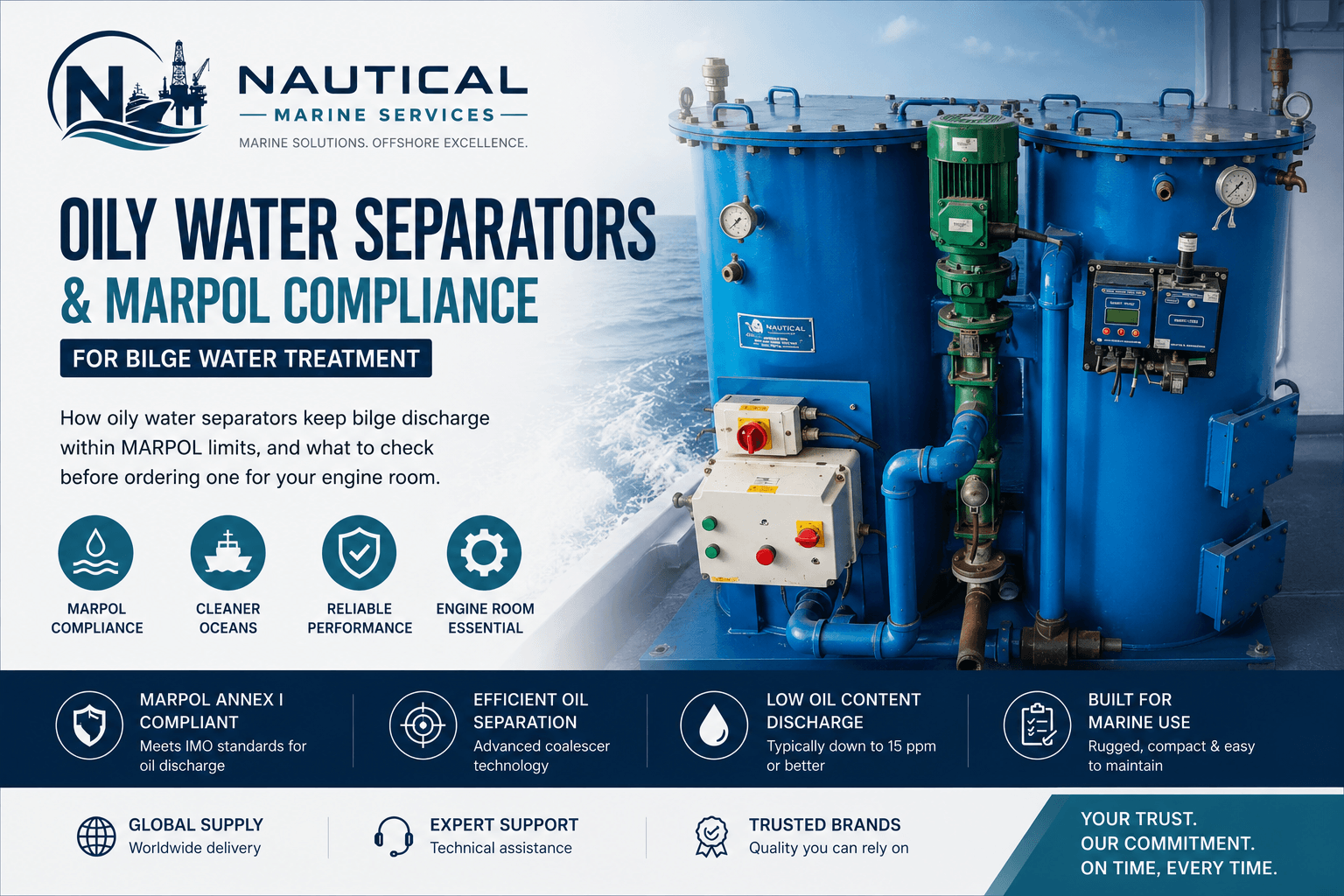
Every vessel with a machinery space accumulates oily bilge water — a mix of engine leakage, condensation and cleaning water that collects in the lowest part of the hull. Discharging this water overboard without treatment is a serious pollution risk, which is why MARPOL Annex I sets a strict limit on how much oil that discharge is allowed to contain. An oily water separator (OWS) is the equipment that makes it possible to stay within that limit. This guide explains how an OWS works and what to check before ordering one for your engine room. Nautical Marine Services supplies oily water separators and bilge water treatment equipment on an order basis — see our full oily water separator range.
What Is an Oily Water Separator?
An oily water separator is a piece of engine room equipment that removes oil from bilge water before it's discharged overboard, bringing the oil content down within the legal limit. It typically works in two stages: a first stage that separates the bulk of free oil by gravity or coalescing, and a second, finer stage — often a filter or coalescer pack — that removes the remaining fine oil droplets.
The MARPOL 15 ppm Limit
MARPOL Annex I requires that bilge water discharged overboard contains no more than 15 parts per million (ppm) of oil, outside of designated Special Areas where discharge is generally prohibited altogether. This limit applies continuously during discharge, not just at a single test point, which is why the treatment system needs both an effective separator and continuous monitoring.
Oil Content Monitor & 15 ppm Bilge Alarm
An oil content monitor (OCM), often called the 15 ppm bilge alarm, continuously measures the oil content of the treated water and automatically stops overboard discharge if the level approaches or exceeds the limit — routing the flow back to the bilge holding tank instead. This unit is a mandatory part of the system, separate from the separator itself, and needs to be kept in working order for the vessel to discharge legally at all.
Types of Separation Stage
Separator designs vary in how they achieve the first and second treatment stages:
Gravity separation — relies on the density difference between oil and water, effective for free (non-emulsified) oil.
Coalescing separation — uses plates or a coalescer pack to merge small oil droplets into larger ones that rise more easily.
Membrane/filtration separation — a fine final stage that filters out oil that gravity and coalescing alone can't remove.
Most compliant systems combine more than one of these stages to reliably reach the 15 ppm limit across varying bilge water conditions.
Capacity & Sizing
Oily water separators are sized by flow rate (m³/h) to match the vessel's bilge pumping capacity and the volume of oily water the machinery space typically generates. Undersizing forces the system to run continuously at full load, which can reduce separation quality; oversizing adds unnecessary cost and space demand. Confirm your vessel's actual bilge water generation rate before specifying a replacement unit.
Approval Standard
Oily water separators for ocean-going vessels are built and tested to the IMO performance standard set out in MEPC.107(49) (which replaced the earlier MEPC.60(33) standard), covering both the separating equipment and the oil content monitor. Confirm which standard your existing unit or replacement is approved under, since older and newer standards test under different conditions.
Oily Water Separator Models We Supply
Below is a reference to the oily water separator and oil content monitor models most commonly requested for bilge water treatment. Nautical Marine Services supplies these on an order basis — see our full oily water separator range.
| Model | Notes |
|---|---|
| JOWA 3SEP | Dual-stage oily water separator, gravity, coalescing and filtration stages |
| RWO OWS | Oily water separator range for bilge water treatment |
| GEA Westfalia BilgeMaster | Centrifugal oily water separator, modular design |
| Alfa Laval PureBilge Compact | Centrifugal oily water separator for smaller vessels and retrofit |
| HSN-Kikai HFM-100 / HFM-500 | Compact bilge oily water separator |
| Rivertrace OCD | Oil content monitor / 15 ppm bilge alarm |
| Deckma OMD Oil Monitor | Oil content monitor / 15 ppm bilge alarm |
JOWA 3SEP
Looking for a JOWA 3SEP specification or price? This dual-stage separator is available in several sizes. Send us your required flow rate to confirm the correct size and current availability.
RWO OWS & GEA Westfalia BilgeMaster
Looking for an RWO OWS price or BilgeMaster specification? Contact us with your vessel's bilge pump capacity to confirm the correct model and current availability.
Alfa Laval PureBilge Compact
Looking for a PureBilge Compact specification or supplier? This unit is commonly specified for smaller vessels and retrofit projects. Contact us with your flow rate requirement to confirm current price.
Rivertrace OCD & Deckma OMD
Looking for a Rivertrace OCD price or Deckma OMD specification? These are the oil content monitors commonly paired with the separators above. Send us your existing sample line details to confirm compatibility and current availability.
Looking to buy or replace an oily water separator or oil content monitor? Send us your required flow rate and existing unit's nameplate details — we confirm current specification, price and lead time before you order.
Operation & Upkeep
Regular upkeep keeps separation performance within spec: coalescer media and filter elements need periodic replacement, the oil content monitor's sample line and sensor need to stay clean, and sludge from the separator needs to be removed to a sludge tank rather than allowed to build up. A unit that isn't kept up will drift out of compliance well before it visibly fails.
Frequently Asked Questions – Oily Water Separators
What is the MARPOL limit for oily bilge water discharge?
MARPOL Annex I sets a 15 parts per million (ppm) oil content limit for bilge water discharged overboard outside Special Areas, monitored continuously by an oil content monitor during discharge.
What is the difference between an oily water separator and an oil content monitor?
The oily water separator removes oil from the bilge water through gravity, coalescing or filtration stages. The oil content monitor is a separate unit that continuously measures the treated water's oil content and stops discharge automatically if the limit is approached.
What standard are marine oily water separators approved to?
Current units are approved under the IMO MEPC.107(49) performance standard, which replaced the earlier MEPC.60(33) standard. Confirm which standard your existing or replacement unit is approved under.
How is an oily water separator sized?
By flow rate (m³/h), matched to the vessel's bilge pumping capacity and the actual volume of oily water the machinery space generates. Confirm your bilge pump capacity before specifying a replacement unit.
Can a vessel discharge bilge water in a Special Area?
Discharge of oily bilge water is generally prohibited within MARPOL Special Areas, regardless of oil content, unless the vessel is in transit and other specific conditions are met — always check the current Special Area rules for the route in question.
Why would a compliant separator still fail a discharge test?
Emulsified oil, detergents, cleaning chemicals and fuel additives can all reduce real-world separation performance even when the unit is within its approved flow rate — separator condition and correct operation matter as much as the nominal spec.
Quick Checklist Before You Order
- Confirm required flow rate (m³/h) against actual bilge water generation
- Check the approval standard (MEPC.107(49) or earlier MEPC.60(33))
- Confirm the oil content monitor is included or compatible with your existing sample line
- Check available space and connection sizes against the existing unit's footprint
- Confirm sludge discharge arrangement to your sludge tank
Once you've confirmed your specification, Nautical Marine Services can check availability from our oily water separator range and arrange delivery to your vessel's next port of call.
Need an Oily Water Separator Fitted to Your Vessel?
Tell us your vessel type and bilge pump capacity — we'll help you match the right specification. Visit us at nauticalmarineservicesglobal.com.
Request a Quote