
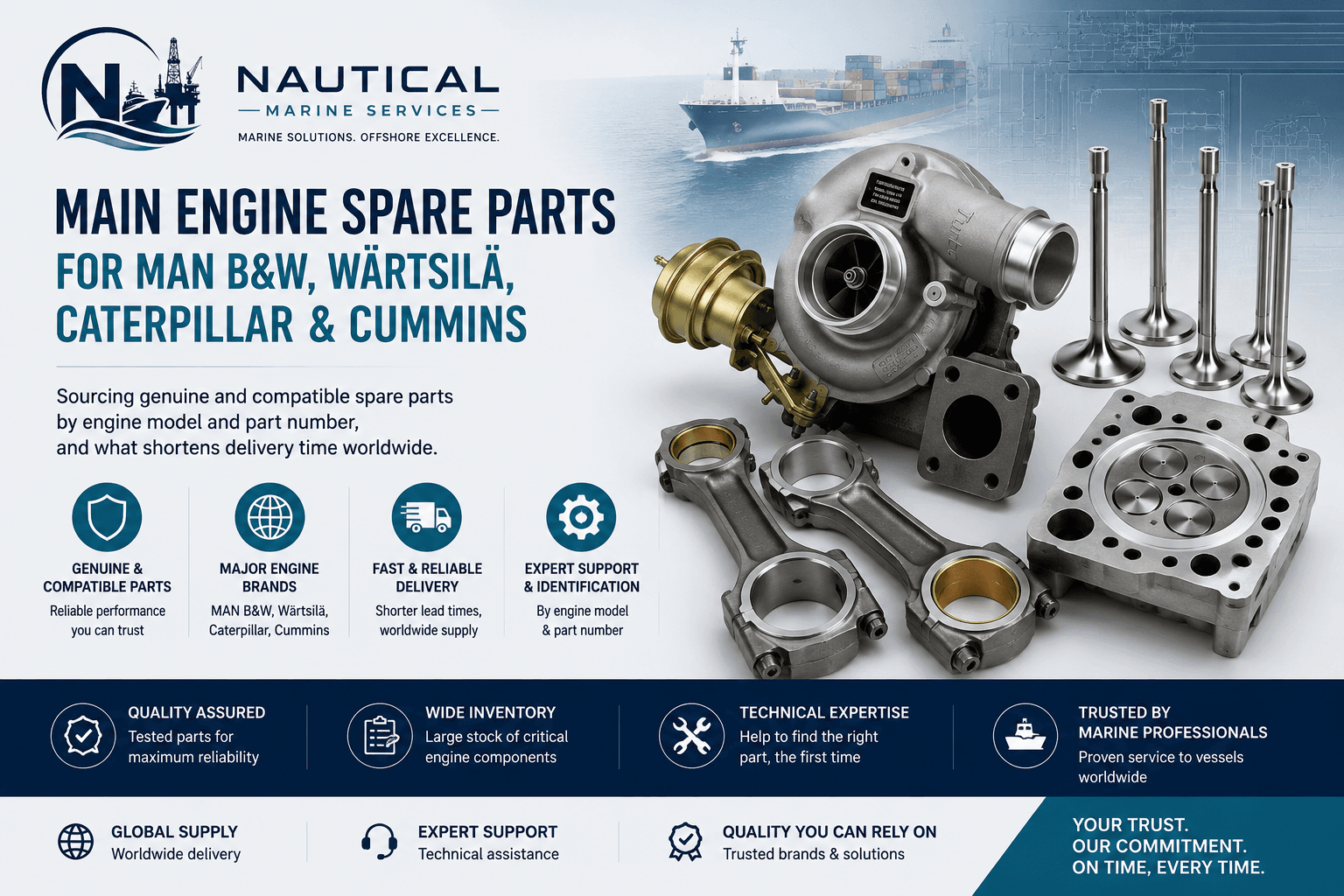
A chief engineer sends over a photo of a worn cylinder liner at 11pm, the vessel's next port call is four days out, and somewhere in that window a part has to be found, confirmed, and moved across the world before the engine can go back together. That's the reality behind most main engine spare part orders — not a catalogue browsing exercise, but a race against a fixed schedule. This page sets out how that race gets won: what identifies a part correctly the first time, how sourcing differs across MAN B&W, Wärtsilä, Caterpillar, Cummins and MTU engines, and where the time actually gets saved. Nautical Marine Services handles main engine spare parts on an order basis — the full main engine spare parts range is here.
Three Details, One Correct Part
Almost every delay traces back to one of three pieces of information being missing at the start of an order:
- Engine make and model / type designation — not just "MAN B&W" but the specific series.
- Part number — from the OEM catalogue, or read directly off the worn component.
- Engine serial number — needed wherever build variants exist within one engine series.
Have all three, and a part can usually be confirmed and quoted the same day. Miss one, and there's a back-and-forth before anything can even be priced — and that back-and-forth is where most of the lost time actually happens, long before the shipment itself.
Parts That Come Up Again and Again
The names change less than people expect. Across brands, the parts that get ordered most are:
| Part | Role |
|---|---|
| Cylinder liner | Bore the piston runs in; wears with running hours |
| Piston & piston rings | Crown, skirt and rings for compression and oil control |
| Cylinder head / cover | Houses valves and injector, seals against combustion pressure |
| Fuel injector | Atomises and injects fuel into the combustion chamber |
| Exhaust & inlet valve | Controls exhaust/scavenge flow; high thermal wear item |
| Turbocharger components | Rotor, bearings, nozzle ring and overhaul parts |
| Main & big-end bearing | Supports crankshaft and connecting rod |
| Connecting rod | Links piston to crankshaft |
| Crankshaft | Converts piston motion to rotational power — major overhaul item |
| Camshaft & drive parts | Controls valve and injection timing |
| Cylinder lubricator components | Delivers cylinder oil to the liner surface |
| Gasket & seal kits | Cylinder head gaskets, O-rings, overhaul seals |
| Filter elements | Fuel, lube oil and air filters — routine replacement |
If you know the part's name but not its number, that's enough to start with — pair it with the engine details above and we'll take it from there.
How Sourcing Differs by Brand
The five brands below cover most of the fleet, but "spare part" doesn't mean the same thing on each of them.
MAN B&W
Two-stroke MAN B&W engines carry most of the world's main propulsion load; the four-stroke line covers auxiliary and smaller-vessel work. Liners, piston crowns and rings, fuel injection gear, exhaust valves and turbocharger parts are the regulars. The catch: bore/stroke configuration and engine series both shift compatibility, so a part that fits one MAN B&W engine can be the wrong one for a different series entirely.
Wärtsilä
Medium-speed Wärtsilä engines split fairly evenly between propulsion and generator duty. Piston sets, liners, injection components, bearings and turbocharger overhaul kits dominate the order list. Part numbering here runs by engine series — get that wrong and the number itself won't lead anywhere useful.
Caterpillar
Caterpillar's marine diesels are the workhorses of auxiliary gensets, workboats and smaller commercial vessels. Injectors, turbochargers, gaskets and filter kits are the usual asks — and the good news is Caterpillar parts are identified straight off a part number, so if that number's readable on the worn item, you're most of the way there already.
Cummins
Much the same territory as Caterpillar. Injectors, turbochargers, filters and gaskets, sourced fastest with a clear part number or, failing that, the engine's serial number.
MTU
High-speed MTU diesels turn up on fast ferries, patrol vessels, workboats and gensets. Fuel injection components, turbochargers, cylinder heads, cooling parts and filter kits are typical requests. MTU is less forgiving on identification than Caterpillar or Cummins — parts get matched against the full type designation and serial number, because build variants within a single series can differ more than a quick look would suggest.
What We Won't Promise
We don't hold stock across five brands and every part number that exists for them — nobody genuinely does. What happens instead is the part gets confirmed against your engine's exact make, model and part number (or serial number) before a lead time gets quoted, rather than a delivery date being promised before the part is even identified. If a serial number is needed to nail down the right build variant, we'll ask for it instead of guessing. And if a timeline genuinely isn't achievable for a given port or part, that gets said at the quote stage — not after you've already committed to a date.
Getting It There Faster
Four things move the needle on delivery time more than anything else:
- The right part, first time — a wrong-part return costs more time than almost anything else in the process.
- A locked-in delivery point — port, date and an agent contact confirmed ahead of arrival.
- Air freight when it's genuinely urgent — faster than sea freight consolidation for anything needed within days.
- Sourcing closer to the destination — where possible, this beats shipping from a single distant hub.
Need a part sourced? Send the engine make, model, part number (or serial number) and delivery port — price and lead time come back before anything's ordered.
Common Questions
What's the minimum I need to give you to start an order?
Engine make and model, plus either a part number or the engine's serial number. Any one of those three missing tends to slow things down before pricing can even happen.
My engine's the same brand as before — can I reuse an old part number?
Not safely. Even within one manufacturer, moving between engine series usually breaks part compatibility, so the series and type designation matter almost as much as the brand.
I don't have a part number — now what?
A clear photo of the worn part, alongside the engine's make, model and serial number, is often enough on its own to identify the right replacement.
What's the single biggest thing that slows delivery down?
Ordering the wrong part and having to re-order. Everything else — freight method, port logistics — matters less than getting the identification right on the first attempt.
Does MTU sourcing work differently from Caterpillar or Cummins?
Yes, somewhat. Caterpillar and Cummins parts are usually identified straight off a part number, while MTU (along with MAN B&W and Wärtsilä) is more commonly matched through the engine's series and full type designation.
Before You Place the Order
- Engine make and model/type designation confirmed
- Part number in hand, or a clear photo of the worn part and its nameplate
- Serial number ready, where build variants apply
- Delivery port and vessel schedule confirmed
- Urgent cases flagged early enough for air freight to be arranged
Once the part's confirmed, Nautical Marine Services can check availability from the main engine spare parts range and arrange delivery to the vessel's next port of call.
Need a Main Engine Spare Part Sourced?
Send the engine make, model and part number — we'll confirm the right match. Visit nauticalmarineservicesglobal.com.
Request a QuoteRelated Reading