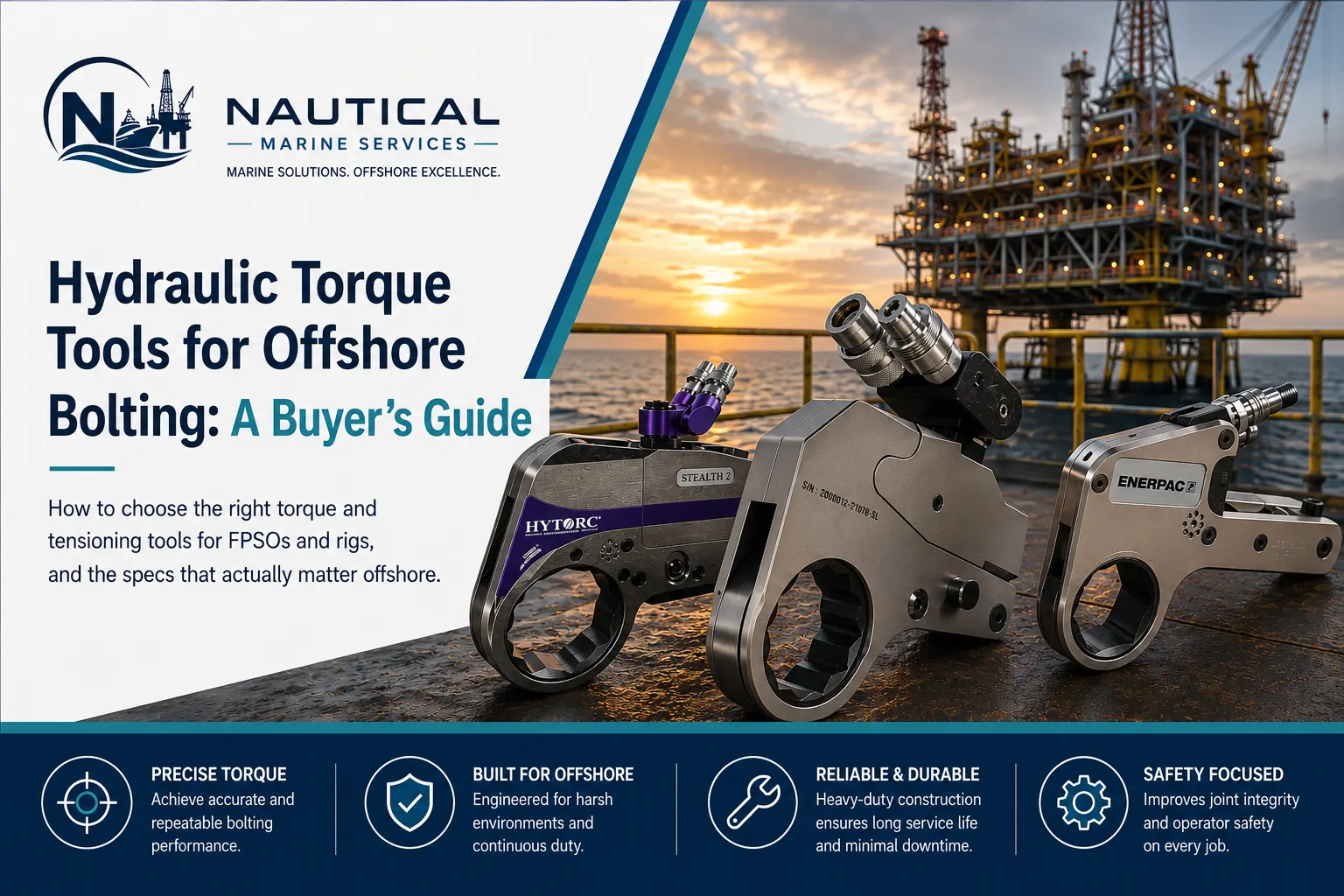
Bolted joints hold the offshore world together — flanges, risers, wellheads, and compressor skids on an FPSO or a jack-up rig all depend on bolt preload that's correct the first time. A missed torque value isn't a warranty callback offshore; it's a leak path on a live hydrocarbon system, or a shutdown while a crew re-enters a confined space to fix it. Choosing the right hydraulic torque or tensioning tool comes down to a handful of specs that matter far more offshore than they do in a yard workshop. At Nautical Marine Services, whoever has a requirement can reach out and we'll help match the right hydraulic torque and tensioning tool — Enerpac, HYTORC, ITH or TorqLite — to the joint and the vessel.
Torque Wrench vs Bolt Tensioner: Picking the Right Method
This is the first decision, and it's driven by the joint, not by preference. A hydraulic torque wrench applies rotational force to the nut through a reaction arm — fast to rig, and needs less clearance around the flange. A bolt tensioner stretches the bolt directly with a hydraulic cylinder before the nut is run down by hand, giving more repeatable preload on large-diameter or safety-critical joints.
- Torque wrench: faster rig-up, smaller footprint, the default for most structural and mid-size flange bolting.
- Bolt tensioner: more repeatable preload on large or critical joints — risers, wellheads, compressor casings — at the cost of more rig-up time and clearance.
A rule that holds for most offshore scopes: reach for a torque wrench by default, and move to tensioning specifically where bolt diameter, joint criticality, or the client's bolting procedure calls for it.
Torque Range and Accuracy
Size the tool to the joint with margin, not to the average bolt on the platform. A wrench running near the top of its range loses accuracy and wears faster; one running near the bottom is imprecise. Most reputable hydraulic torque wrenches hold a constant torque output with an accuracy of ±3% across the full stroke, but always ask for the accuracy figure at your actual working torque, not just the headline maximum.
Hazardous Area Certification and Corrosion Resistance
Hydraulic tools are non-sparking by nature, but the pump driving them often isn't. Electric and pneumatic pumps used in classified zones need ATEX or IECEx certification matched to the zone rating and gas group of the specific area — check the certificate against the zone, not a general "offshore-rated" claim on a spec sheet. Salt air also finds every unprotected surface, so look for plated or stainless fasteners on the tool body and a stated IP rating on the pump and hose assembly, not only the wrench head.
Access and Confined Space
Weight and reaction-arm profile matter as much as torque output on a platform where bolts sit in a pipe rack or under a grating. Low-profile hexagon wrenches with interchangeable cassettes are the standard answer for restricted clearance around the nut — a common condition in oil and gas and offshore work — letting one drive unit cover a wide range of bolt sizes without carrying five separate wrenches.
Calibration and Traceability
Offshore bolting is normally run as controlled bolting, with every torque or tension value logged and traceable back to a calibration certificate. Most operators calibrate every 12 months, or after a set number of duty cycles, in line with ISO 6789. A tool that's been dropped, overloaded, or exposed to a saltwater immersion event should be recalibrated immediately regardless of the schedule.
FPSO and Rig-Specific Considerations
- Zone mapping changes by area. Turret, process deck, and accommodation block on an FPSO can carry different zone classifications — confirm the certification needed for each specific bolting location, not the vessel as a whole.
- Riser and BOP stack bolting. Large-diameter, safety-critical joints where tensioning is frequently specified over torque, and where subsea-rated or ROV-compatible tooling may be required below the waterline.
- Drill floor red zone rules. Powered tools used near the rotary table are often restricted by the rig's own procedures — confirm compatibility with the rig's hazard management plan before mobilizing equipment.
- Logistics. Everything offshore travels by crane basket or helicopter net; check a tensioner set's total weight and case dimensions against the vessel's lift and space allowances, not just its technical spec.
Choosing the Pump
| Pump Type | Best Suited To |
|---|---|
| Electric | Topside bolting with shore or generator power available |
| Pneumatic | Classified hazardous areas with compressed air already routed |
| Battery | Short, mobile jobs in confined or hard-to-reach spaces |
| Manual / hand | Backup or very low bolt-count jobs |
Match the pump to the zone rating first, and to the job's mobility needs second — a pump that isn't rated for the area it's used in is a bigger risk than one that's merely underpowered.
Torque & Tensioning Brands & Series We Work With
Most vessels and platforms we support are already running one of a handful of established bolting tool brands. Below is a reference on the series you're likely to come across — Enerpac, HYTORC, ITH and TorqLite — along with what each is generally used for. Nautical Marine Services supplies units across these brands on an order basis — see our full hydraulic torque and tensioning tools range.
Enerpac Torque Wrench Series
Enerpac is one of the most widely specified torque wrench brands on offshore and marine bolting scopes. Below are the series we most commonly supply, from the square-drive S-Series to the ATEX-certified, low-profile W-Series.
| Series / Model | Notes |
|---|---|
| Enerpac S-Series | Square drive, repetitive heavy industrial use, ATEX declared, calibration certificate included |
| Enerpac S25000X | Square drive wrench, 26,150 ft-lb torque, 2½ in. square drive |
| Enerpac W-Series | Low-profile hexagon, interchangeable cassettes, ATEX certified for restricted-clearance work |
| Enerpac HMT Series | Modular design, interchangeable hex and square-drive cassettes, CE-ATEX certified |
| Enerpac S- & W-Series X-Edition | Updated generation of the S- and W-Series controlled bolting tools |
Enerpac S-Series
Looking for the Enerpac S-Series specification? This square-drive wrench is built for repetitive heavy industrial use, with ATEX declaration and a calibration certificate included as standard. We can confirm current price and lead time for your torque range and vessel type.
Enerpac W-Series
The W-Series is a low-profile hydraulic torque wrench built for restricted clearance around the nut, common on oil and gas and offshore work, with a torque range spanning roughly 204 to 35,000 ft-lb. Ask us about ATEX-certified drive units and compatible cassettes for your bolt sizes.
Enerpac HMT Series
Looking for the Enerpac HMT Series specification? Its modular design accepts interchangeable low-profile hexagon and square-drive cassettes, with an accuracy of ±3% across the full stroke and CE-ATEX certification. Contact us to confirm current price and configuration.
Looking to buy or replace an Enerpac torque wrench? Contact us with your torque range and vessel type — we confirm current specification, price and lead time before you order.
HYTORC Torque Wrench Series
HYTORC's hydraulic lineup is built around a small number of series covering a wide torque range, most commonly requested for high-cycle industrial and offshore use.
| Series | Notes |
|---|---|
| HYTORC MXT | Square drive workhorse series, eight models covering roughly 118 to 37,100 ft-lb |
| HYTORC MXT+ | Upgraded variant with multi-direction hose swivel, lock-on release, auto pressure release and a cycle counter, torque range roughly 205\u201312,148 ft-lb |
HYTORC MXT & MXT+
Looking for a HYTORC MXT specification or current pricing? The MXT+ adds hardware upgrades over the standard MXT, including a cycle counter for maintenance tracking — useful for operators running formal calibration and duty-cycle logs offshore. Send us your torque range requirement and we'll confirm the right model.
ITH Bolting Technology
ITH supplies torque wrenches and hydraulic tensioning cylinders built specifically around marine and offshore bolt connections — engine assembly, platform maintenance, and general marine technology work.
ITH Torque Wrenches & Tensioning Cylinders
ITH's bolting technology is aimed at safe, precise and economical bolt connections for shipyards, suppliers and operators looking to minimise downtime. We supply ITH torque wrenches and tensioning cylinders to order — contact us with your joint specification.
TorqLite Riser Tools & Subsea Bolt Tensioners
For riser and subsea scopes specifically, a small number of specialist tools cover what a standard topside wrench or tensioner can't reach.
| Tool | Notes |
|---|---|
| TorqLite RT Series | Industrial riser tools designed to quickly make up or break out riser bolts with high precision, widely used in offshore oil and gas, marine and energy sectors |
| Subsea hydraulic bolt tensioner | Designed for underwater bolting on subsea structures such as pipelines and offshore platforms, with sealed, corrosion-resistant construction for deep-water use |
Subsea & ROV-Compatible Tensioners
Subsea tensioners are typically built with remote-control capability so divers or ROVs can tighten and release bolts with minimal manual effort, which matters on riser and BOP stack work below the waterline. Contact us with your water depth and connection type to confirm the right unit.
Frequently Asked Questions – Offshore Torque & Tensioning Tools
Should offshore crews use a torque wrench or a bolt tensioner?
Torque wrenches rotate the nut and are the default for most flange and structural bolting because they rig up faster and need less clearance. Bolt tensioners stretch the bolt directly and are preferred for large-diameter, high-load, or safety-critical joints such as riser flanges, wellheads, and compressor casings, where friction-driven torque values would be inconsistent.
What certification should offshore torque tools have for hazardous areas?
Tools and pumps used in classified zones should carry ATEX or IECEx certification matched to the zone rating (commonly Zone 1 or Zone 2) and gas group of the installation. Hydraulic tools are inherently non-sparking, but electric or pneumatic pumps used alongside them still need the correct rating — check the paperwork against the specific zone, not a generic "offshore-rated" label.
How often should hydraulic torque tools be calibrated?
Most operators calibrate every 12 months or after a set number of duty cycles, whichever comes first, in line with ISO 6789 traceability requirements. Tools dropped, overloaded, or exposed to a saltwater immersion event should be recalibrated immediately regardless of the schedule.
What is the difference between Enerpac S-Series and W-Series torque wrenches?
The S-Series is a square-drive wrench built for repetitive heavy industrial use. The W-Series is a low-profile hexagon wrench designed for restricted clearance around the nut, common in oil and gas and offshore work, and is available with ATEX certification.
What's the difference between HYTORC MXT and MXT+?
The MXT is HYTORC's square-drive workhorse series covering a wide torque range. The MXT+ adds hardware upgrades — a multi-direction hose swivel, lock-on release, auto pressure release, and a cycle counter — over a narrower torque band, aimed at high-cycle industrial use.
What torque pump type works best on an FPSO or rig?
Electric pumps suit topside bolting where shore or generator power is available. Pneumatic pumps suit classified hazardous areas or sites where compressed air is already routed. Battery pumps suit short, mobile jobs in confined spaces where a trailing hose or cable is impractical.
Quick Checklist Before You Order
- Confirm torque or tension method against the joint and the client's bolting procedure
- Size torque range with margin above your largest bolt
- Verify ATEX/IECEx certificate against the specific zone and gas group
- Check cassette or hex range covers the platform's bolt sizes
- Confirm calibration certificate is current and traceable to ISO 6789
- Match pump type to zone rating and available power or air on site
Once you've confirmed your specification, Nautical Marine Services can check availability from our hydraulic torque and tensioning tools range and arrange delivery to your vessel or platform's next port of call.
Need Bolting Tools Fitted to Your Vessel or Platform?
Tell us your joint type, torque range and operating zone — we'll help you match the right tool. Visit us at nauticalmarineservicesglobal.com.
Request a QuoteRelated Reading