
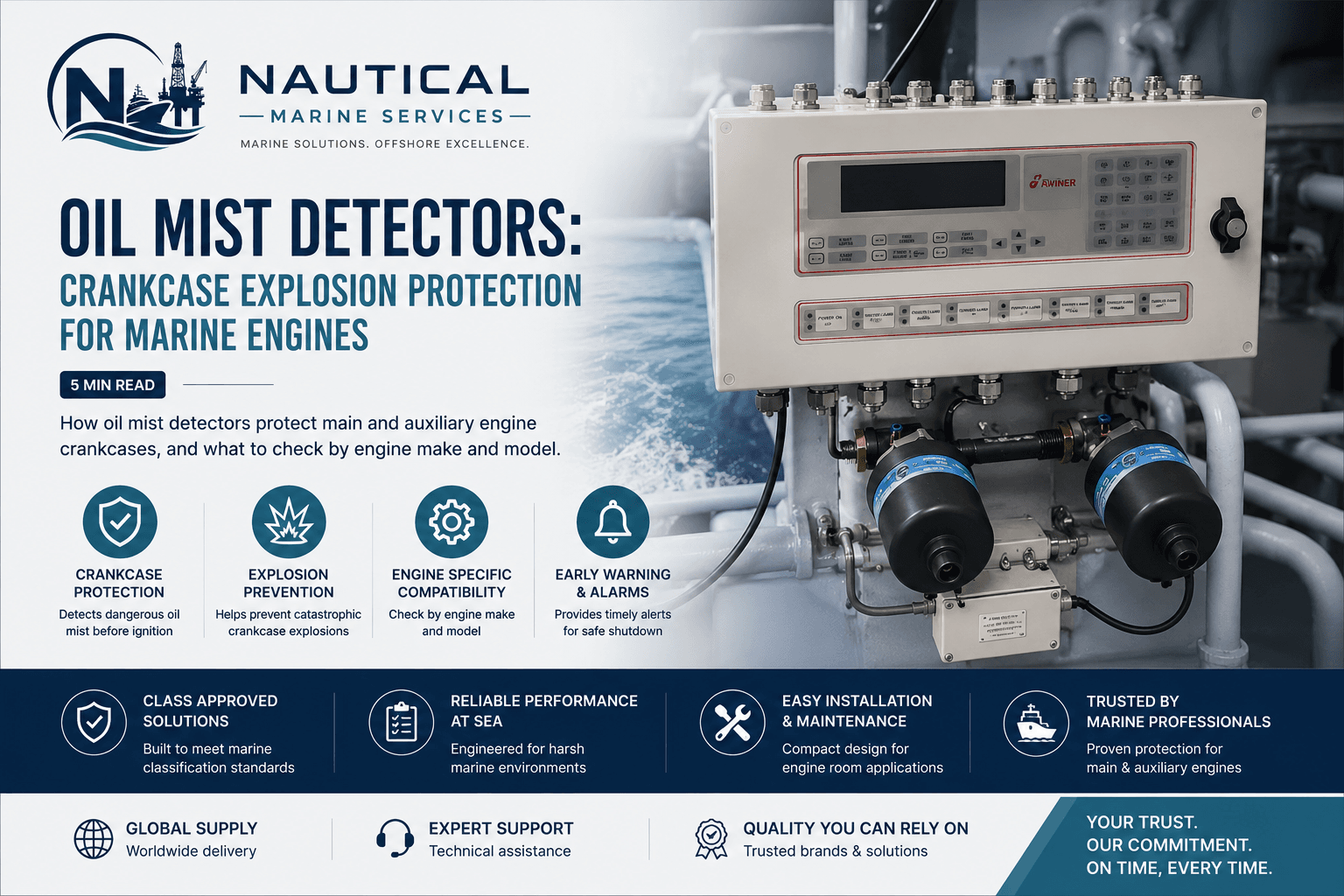
A crankcase explosion is one of the most destructive failures a marine engine can suffer, and it starts with something almost invisible: a fine mist of lubricating oil building up inside the crankcase. If that mist contacts a hot spot — an overheated bearing, a rubbing piston — it can ignite. The first, primary explosion is usually vented safely through relief doors, but the resulting pressure drop can draw in fresh air and trigger a much more violent secondary explosion, capable of blowing out crankcase doors and starting a fire in the engine room. An oil mist detector exists to catch the problem before it reaches that point. Nautical Marine Services supplies oil mist detectors and related crankcase monitoring equipment on an order basis — see our full oil mist detector range.
What Is an Oil Mist Detector?
An oil mist detector is a monitoring instrument that continuously draws air samples from points along the engine crankcase and measures oil mist density using light scattering across a photoelectric cell. A reference cell using clean air is compared against the sample cell, and if the difference indicates rising oil mist concentration, the unit raises an alarm well before the mixture reaches an explosive level.
Which Engines Typically Need Oil Mist Detection
Crankcase oil mist detection is typically fitted on diesel engines of 2,250 kW and above, or with cylinders of more than 300 mm bore, either as a crankcase oil mist detector or an engine bearing temperature monitor. This applies to both main propulsion and auxiliary engines meeting that threshold. On main engines, an oil mist alarm is typically linked to an automatic slowdown; on auxiliary engines, the response is generally alarm and manual action rather than automatic slowdown.
How Detection & Alarm Response Works
Most crankcase oil mist detectors work on either a single rotating sampling head that cycles through multiple sampling points, or a multi-point continuous system that monitors several points simultaneously. Either way, the detector reports oil mist density per sampling point, so the crew can identify which section of the crankcase — and therefore which bearing or cylinder area — is generating the mist, rather than just getting a single engine-wide reading.
Checking Against Engine Make & Model
An oil mist detector has to be matched to the specific engine it's protecting, not just its power rating. The number of cylinders determines how many sampling points are needed, the crankcase layout determines sampling tube routing and length, and the engine manufacturer's approval confirms which detector types are accepted for that engine make and model. Before ordering a replacement or upgrade, confirm the exact engine make, model, cylinder count and existing detector interface (alarm/shutdown wiring) so the replacement unit integrates correctly.
Oil Mist Detector Models We Supply
Below is a reference to the oil mist detector models most commonly requested for main and auxiliary engine crankcase protection. Nautical Marine Services supplies these on an order basis — see our full oil mist detector range.
| Detector Model | Notes |
|---|---|
| Schaller Visatron VN 87 | Rotating single-head crankcase oil mist detector |
| Schaller Visatron VN 115/87 | Crankcase oil mist detector, larger sampling point count |
| Schaller Visatron VN 215/87 | Crankcase oil mist detector for higher-cylinder-count engines |
| Schaller Visatron VN 2020 | Continuous multi-point crankcase oil mist detector |
| Kidde Graviner MK5 | Crankcase oil mist detector |
| Kidde Graviner MK6 | Crankcase oil mist detector |
| Kidde Graviner MK7 | Crankcase oil mist detector |
| Daihatsu MD-9M | Crankcase oil mist detector for Daihatsu-built engines |
Schaller Visatron VN 87 / VN 115/87 / VN 215/87
Looking for a Visatron VN 87 specification or Visatron VN 115/87 price? These rotating single-head detectors cover a range of cylinder counts. Send us your engine make, model and cylinder count to confirm the correct variant and current availability.
Schaller Visatron VN 2020
Looking for a Visatron VN 2020 specification or supplier? This continuous multi-point unit is commonly requested as a replacement for older VN 87-series detectors. Contact us with your engine details to confirm compatibility and current price.
Kidde Graviner MK5 / MK6 / MK7
Looking for a Graviner MK5 price, MK6 specification or MK7 supplier? Send us your engine make, model and cylinder count and we'll confirm the correct unit and current availability.
Daihatsu MD-9M
Looking for a Daihatsu MD-9M specification or supplier? This detector is commonly fitted on Daihatsu-built engines. Contact us with your engine details to confirm current price and availability.
Looking to buy or replace an oil mist detector? Send us your engine make, model and cylinder count — we confirm current specification, price and lead time before you order.
Atmospheric Oil Mist Detectors
Beyond crankcase monitoring, atmospheric oil mist detectors are also fitted in enclosed spaces where oil mist could accumulate in open air — such as purifier rooms, high-pressure pump rooms and other machinery spaces — as an additional layer of fire and safety monitoring separate from the crankcase-specific unit.
Testing & Upkeep
Sampling lines and sensor heads need to stay clean and unobstructed for accurate readings — a blocked sampling point can mask a real problem in exactly the area it's meant to protect. Alarm and shutdown functions should be function-tested at the interval set by the engine manufacturer and class requirements, not left until the next survey.
Frequently Asked Questions – Oil Mist Detectors
What engines typically need a crankcase oil mist detector?
Crankcase oil mist detection (or an equivalent device) is typically fitted on diesel engines of 2,250 kW and above, or with cylinders of more than 300 mm bore, covering both main and auxiliary engines in that range.
How does an oil mist detector actually detect oil mist?
It draws air samples from the crankcase and measures oil mist density using light scattering across a photoelectric cell, comparing the sample against a clean-air reference cell to detect rising concentration before it reaches an explosive level.
What happens when an oil mist detector alarms on a main engine?
On main engines, an oil mist alarm is typically linked to an automatic slowdown to reduce the risk of ignition. On auxiliary engines, the response is generally an alarm requiring manual action rather than automatic slowdown.
Does the oil mist detector need to match my specific engine model?
Yes — the number of cylinders, crankcase layout and manufacturer approval all affect which detector will integrate correctly. Confirm your engine make, model and cylinder count before ordering a replacement.
Is an oil mist detector needed on smaller engines below that power range?
It's not typically fitted as standard, but it's still worth considering — an oil mist detector gives an early warning of bearing wear or lubrication problems that could otherwise go undetected until serious damage occurs.
What is an atmospheric oil mist detector, and is it different from a crankcase unit?
An atmospheric oil mist detector monitors open engine room spaces — such as purifier rooms or pump rooms — for oil mist in the air, separate from a crankcase detector which monitors inside the engine's crankcase itself.
Quick Checklist Before You Order
- Confirm engine make, model and number of cylinders
- Check whether the engine is in the 2,250 kW / 300 mm bore range typically fitted with detection
- Confirm single rotating-head or multi-point continuous sampling requirement
- Check existing alarm/shutdown wiring interface for compatibility
- Confirm whether an atmospheric detector is also needed for adjacent machinery spaces
Once you've confirmed your specification, Nautical Marine Services can check availability from our oil mist detector range and arrange delivery to your vessel's next port of call.
Need an Oil Mist Detector Fitted to Your Vessel?
Tell us your engine make, model and cylinder count — we'll help you match the right specification. Visit us at nauticalmarineservicesglobal.com.
Request a QuoteRelated Reading

Oily Water Separators & MARPOL Compliance
Engine Room