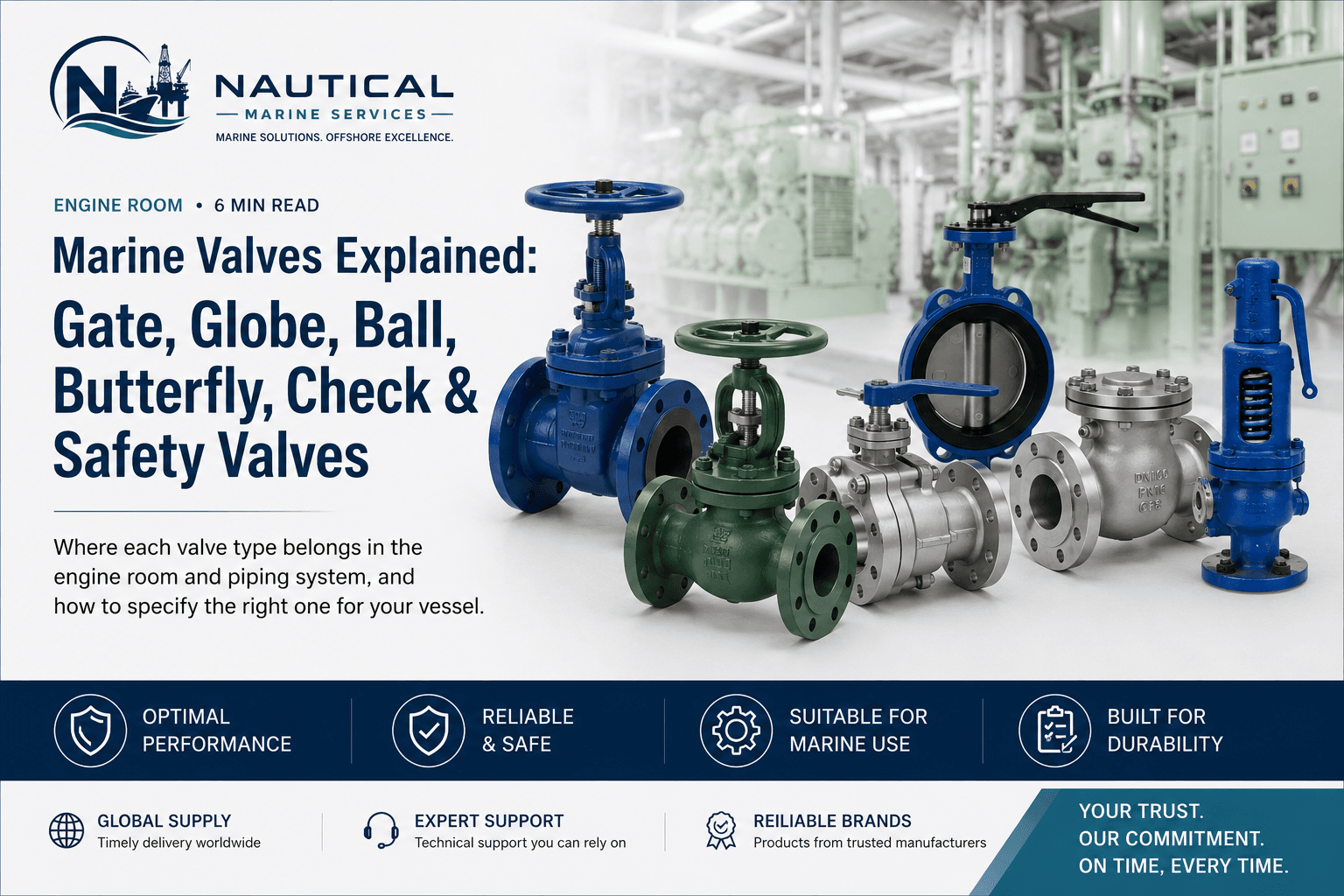
Every piping system on a vessel — ballast, bilge, cooling water, fuel oil, steam and fire fighting — depends on valves to control, isolate or protect the flow. Picking the wrong valve type for a given duty is one of the most common (and costly) specification mistakes in engine room work: a gate valve used where a globe valve is needed for throttling, or a check valve rated for the wrong direction of flow. This guide explains where each valve type belongs in the system, the standards and materials to check before ordering, and how to specify the right valve for your vessel. Nautical Marine Services supplies gate, globe, ball, butterfly, check and safety valves on an order basis — see our full marine valves range.
Gate Valve
A gate valve is an on/off (isolation) valve — not designed for throttling. A flat gate lowers into the flow path to fully block it, giving a straight-through bore with minimal pressure drop when fully open. Gate valves are widely used on ballast lines, sea water suction and discharge lines, and fuel transfer lines where full flow with low resistance matters more than fine flow control.
Where it's used
Ballast main lines, sea chest suction/discharge, fuel oil transfer lines, cargo lines. Marine gate valves are commonly non-rising stem type to save headroom in confined engine room spaces.
Looking for a marine gate valve specification or JIS 10K gate valve price? Send us the line size, pressure rating and fluid service and we'll confirm current specification and availability.
Globe Valve
A globe valve is built for throttling and flow regulation, not just on/off duty. Flow passes through an S-shaped path across a disc and seat, which gives good control but a higher pressure drop than a gate valve of the same size. Globe valves are the standard choice for cooling water regulation, fuel oil control and steam service where flow needs to be adjusted, not just stopped.
Where it's used
Cooling fresh/sea water regulation, fuel oil and lube oil control lines, steam and condensate systems. Y-pattern globe valves are common on steam lines for reduced pressure drop.
Looking for a marine globe valve specification or bronze globe valve price? Contact us with your line size and pressure class to confirm current availability.
Ball Valve
A ball valve uses a rotating bored ball to open or close flow with a quarter-turn — fast operation, tight bubble-tight shut-off, and a compact footprint. Available in floating and trunnion-mounted designs, with trunnion types better suited to higher-pressure lines. Widely used where quick isolation and reliable sealing matter, including remote-operated and automated valve stations.
Where it's used
Sea water and fresh water isolation, fuel oil quick-shutoff, sounding and sampling lines, remote/actuated valve stations on ballast and cargo systems.
Looking for a marine ball valve specification or stainless steel ball valve price? Send us your line size and actuation requirement (manual, pneumatic or electric) to confirm availability.
Butterfly Valve
A butterfly valve uses a rotating disc on a shaft to control flow — compact, lightweight and quick to operate, making it a common choice where space and weight are limited (a major factor in engine room design). Butterfly valves are used both for on/off isolation and, with the right disc design, for throttling duty.
Where it's used
Sea water cooling systems, ballast lines, general service piping, HVAC and large-diameter lines where a gate valve would be too bulky or heavy.
Looking for a marine butterfly valve specification or wafer type butterfly valve price? Contact us with your line size, pressure rating and actuation type.
Check Valve (Non-Return Valve)
A check (non-return) valve allows flow in one direction only and closes automatically to prevent backflow — critical on bilge, ballast and pump discharge lines where reverse flow could flood a compartment or damage a pump. Swing check and wafer/dual-plate check are the most common types on board, chosen for their compact size and reliable closing action.
Where it's used
Bilge pump discharge lines, ballast pump discharge, sea water pump discharge, fuel and lube oil transfer lines. Wafer (multi-flange) check valves are common where space is tight.
Looking for a marine check valve specification or swing check valve price? Send us your line size and pressure rating to confirm current availability.
Safety Valve (Relief Valve)
A safety (relief) valve automatically opens once system pressure exceeds a set threshold, protecting boilers, pressure vessels, air receivers and piping from over-pressure damage. Safety valves are a class-surveyed, safety-critical item — set pressure and capacity must match the protected equipment exactly, and they require periodic testing.
Where it's used
Boilers, steam systems, air receivers, pressure vessels, and any closed system where over-pressure could cause equipment failure or injury.
Looking for a marine safety valve specification or a relief valve supplier? Send us the set pressure, capacity and equipment it protects so we can confirm the correct unit and current availability.
Material & Standard Considerations
Marine valves handling seawater are typically bronze or cast iron with a corrosion-resistant trim; higher-pressure steam and fuel lines commonly use forged or cast steel. Most vessels are built to either JIS (common on Japanese-built tonnage), DIN or ANSI/ASME flange and pressure standards — confirm which standard your existing valve is built to before ordering, since flange drilling and pressure ratings aren't interchangeable between standards.
Marine Valves We Work With
Below is a quick reference to the valve types covered in this guide, and where each belongs in a vessel's piping system. Nautical Marine Services supplies valves across all of these types on an order basis — see our full marine valves range.
| Valve Type | Notes |
|---|---|
| Gate Valve | On/off isolation, minimal pressure drop when fully open |
| Globe Valve | Flow regulation and throttling duty |
| Ball Valve | Quick quarter-turn isolation, tight bubble-tight shut-off |
| Butterfly Valve | Compact, lightweight isolation and throttling |
| Check Valve | One-direction flow, prevents backflow |
| Safety Valve | Automatic over-pressure protection |
Frequently Asked Questions – Marine Valves
What is the difference between a gate valve and a globe valve?
A gate valve is an on/off isolation valve with minimal pressure drop when fully open, but is not designed for throttling. A globe valve is built for flow regulation and throttling, with a higher pressure drop even when fully open.
When should I use a ball valve instead of a butterfly valve?
Ball valves give tighter bubble-tight shut-off and are preferred for higher-pressure or critical isolation duty. Butterfly valves are lighter and more compact, making them the common choice for large-diameter, lower-pressure lines such as sea water cooling systems.
Where are check valves required on a vessel?
Check valves are fitted on bilge, ballast and sea water pump discharge lines to prevent backflow that could flood a compartment or damage a pump. Swing check and wafer/dual-plate check valves are the most common marine types.
How do I specify a marine safety valve?
You need the set pressure, required relieving capacity, and the exact equipment being protected (boiler, air receiver, pressure vessel). Safety valves are safety-critical and class-surveyed items, so the set pressure and capacity must match the protected equipment exactly.
What's the difference between JIS, DIN and ANSI valve standards?
These are different flange drilling and pressure rating standards — JIS is common on Japanese-built tonnage, DIN on European-built vessels, and ANSI/ASME on US-built vessels. Flanges and pressure ratings are not directly interchangeable between standards, so always confirm which one your existing valve is built to.
What material should a sea water valve be made from?
Sea water valves are typically bronze or cast iron with a corrosion-resistant trim, chosen to resist continuous exposure to seawater. Confirm the exact material spec against your existing valve before ordering a replacement.
Quick Checklist Before You Order
- Confirm valve type needed: isolation (gate/ball/butterfly) or regulation (globe)
- Check line size, pressure class and standard (JIS / DIN / ANSI)
- Match body and trim material to the fluid service (seawater, fuel, steam)
- For check valves, confirm the required flow direction and valve type (swing vs. wafer)
- For safety valves, confirm set pressure, capacity and equipment being protected
Once you've confirmed your specification, Nautical Marine Services can check availability from our marine valves range and arrange delivery to your vessel's next port of call.
Need Valves Fitted to Your Vessel?
Tell us your vessel type, line size and valve duty — we'll help you match the right specification. Visit us at nauticalmarineservicesglobal.com.
Request a Quote