
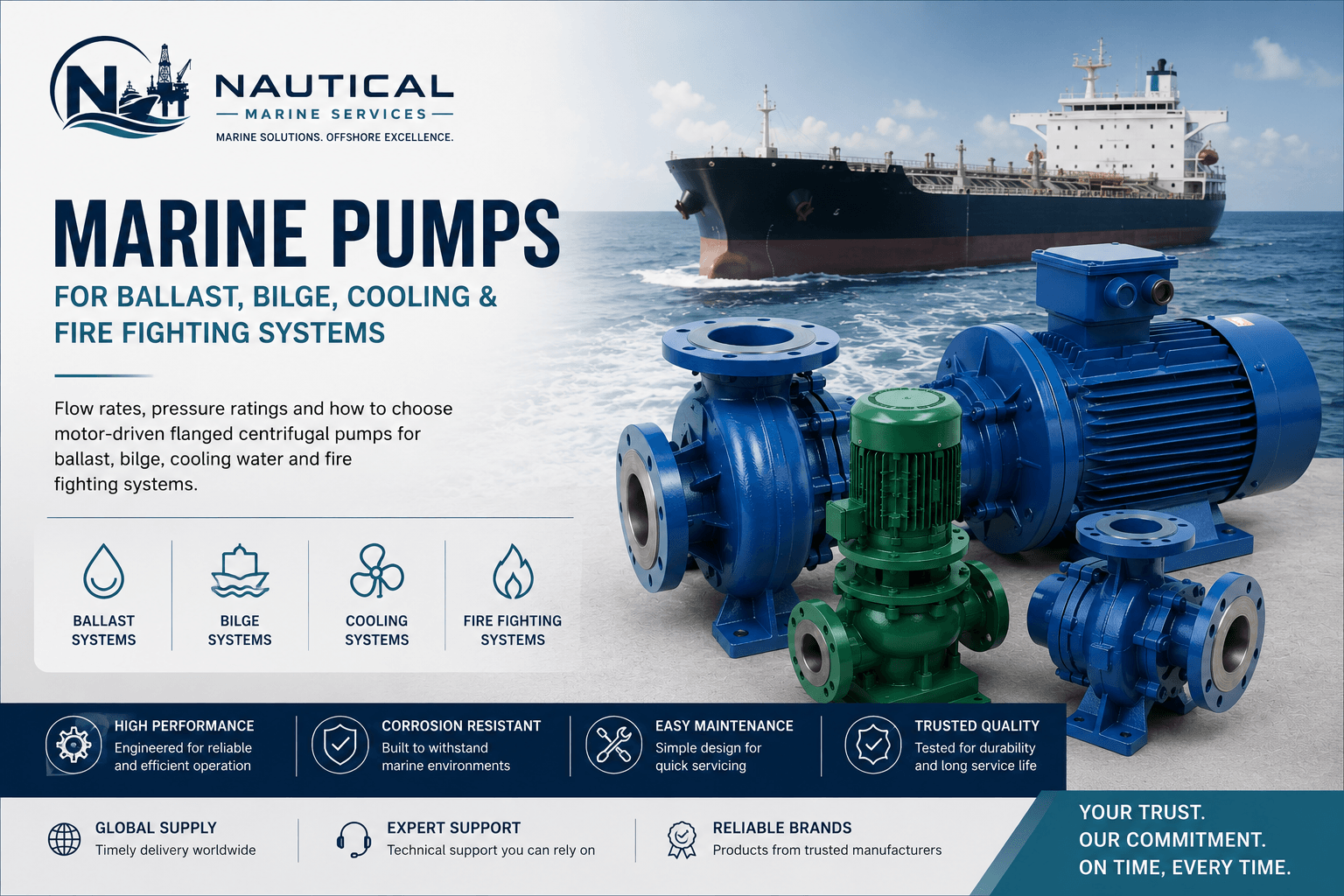
Motor-driven flanged centrifugal pumps are among the most heavily used equipment in a ship's engine room. They move seawater and fresh water for ballast control, bilge drainage, engine cooling and emergency fire fighting — often around the clock. Choosing the right pump comes down to matching flow rate, head (pressure), and construction material to the actual duty, rather than picking whatever unit happens to be in stock. This guide covers the key specifications to check before ordering, and the pump types most commonly requested for marine engine room service.
Ballast Pump
Ballast pumps move large volumes of seawater to control a vessel's trim, draft and stability during loading, discharge and voyage conditions. They need to handle continuous operation and corrosive seawater without losing efficiency, and are typically specified by flow rate (m³/h) and head (m) at the vessel's ballast system design point.
Looking for a ballast pump specification or ballast pump price? Contact us with your vessel's flow rate and head requirement to confirm current availability.
Bilge Pump
Bilge pumps remove water that collects in the lowest parts of the hull — often mixed with oil residue — keeping machinery spaces dry and safe. Many vessels run a dedicated bilge pump alongside a general service or fire pump that can take over bilge duty in an emergency, so compatibility between units matters as much as the pump's own spec.
Looking for a bilge pump specification or bilge pump supplier? Send us your line size and capacity requirement to confirm current price and availability.
Cooling Water Pump
Cooling pumps circulate seawater or fresh water to regulate main engine and auxiliary machinery temperature. Sea water cooling pumps are usually bronze or cast iron with a corrosion-resistant impeller, while fresh water (jacket) cooling circuits often use a different material spec — always confirm which side of the system the pump is replacing before ordering.
Looking for a cooling water pump specification or sea water cooling pump price? Contact us with your existing pump's flow rate and head to confirm a suitable replacement.
Fire Fighting Pump
Fire and general service pumps supply pressurised water for onboard fire fighting and frequently double as ballast, bilge or deck-wash pumps when not needed for fire duty. Class rules require a minimum number and capacity of fire pumps depending on vessel size, plus an independently powered emergency fire pump located outside the main engine room.
Looking for a fire pump specification or emergency fire pump supplier? Send us your required capacity and pressure to confirm current availability.
General Service Pump
General service pumps are dual-rated units that can be switched between fire fighting, ballast, bilge or deck-wash duty as needed, giving flexibility without adding a dedicated pump for every task. They are sized to meet the highest of these duty requirements.
Fresh Water & Sanitary Pump
Fresh water and sanitary pumps supply domestic fresh water and sanitary systems onboard, kept separate from seawater duty pumps to avoid contamination.
Boiler Feed Pump
Boiler feed pumps supply feed water to the boiler under pressure, and are typically multi-stage centrifugal pumps built to handle higher head and hot feed water temperatures.
Ejector
Ejectors have no moving parts and use a motive fluid to draw and discharge liquid — commonly used for ballast stripping, bilge and sewage applications where a conventional pump isn't practical.
Material & Construction
Marine pumps handling seawater are typically built in bronze or cast iron with a phosphor bronze or stainless steel impeller and shaft, to resist corrosion in continuous seawater service. Confirm casing material, shaft seal type (mechanical seal vs. gland packing) and coupling type (close-coupled vs. spacer coupling) against your existing pump before ordering a replacement — we work on an order basis and can arrange urgent supply once the spec is confirmed.
Flow Rate & Pressure Ratings
Every pump is specified by its duty point — flow rate in m³/h and total head in metres or bar. Match the replacement pump's duty point to your system's actual requirement rather than defaulting to the highest-capacity unit available; an oversized pump wastes power and can cause cavitation issues at partial load.
Frequently Asked Questions – Marine Pumps
What is the difference between a ballast pump and a bilge pump?
A ballast pump moves large volumes of seawater to control a vessel's trim and stability, while a bilge pump removes accumulated water (often mixed with oil residue) from the lowest parts of the hull. Many vessels use pumps rated for both duties, referred to as bilge & ballast pumps.
Can a fire pump be used as a general service pump?
Yes — fire and general service pumps are commonly rated for dual duty and can assist with ballasting, deck washing or bilge transfer when not needed for fire fighting, subject to class approval for the specific vessel.
What material should a seawater cooling pump be made from?
Seawater cooling pumps are typically bronze or cast iron with a phosphor bronze or stainless steel impeller and shaft, to resist corrosion under continuous seawater service. Confirm the exact material spec against your existing pump before ordering a replacement.
What is an ejector used for on a vessel?
Ejectors have no moving parts and use a motive fluid to draw and discharge liquid, commonly used for ballast stripping, bilge and sewage applications where a conventional pump isn't practical.
How do I identify which marine pump my vessel is running?
A photo of the pump nameplate — showing manufacturer, duty and serial number — is usually enough for us to confirm the exact specification and current availability.
Quick Checklist Before You Order
- Confirm duty: ballast, bilge, cooling water or fire & general service
- Match flow rate (m³/h) and head (m or bar) to the actual system design point
- Check casing and impeller material against seawater or fresh water service
- Verify shaft seal type (mechanical seal vs. gland packing) and coupling type
- Confirm motor power, voltage and frequency against the existing pump — we supply on an order basis with urgent supply available
Once you've confirmed your specification, Nautical Marine Services can check availability from our marine pumps range and arrange delivery to your vessel's next port of call.
Need a Pump Fitted to Your Vessel?
Tell us your vessel type and pump duty — we'll help you match the right specification. Visit us at nauticalmarineservicesglobal.com.
Request a Quote